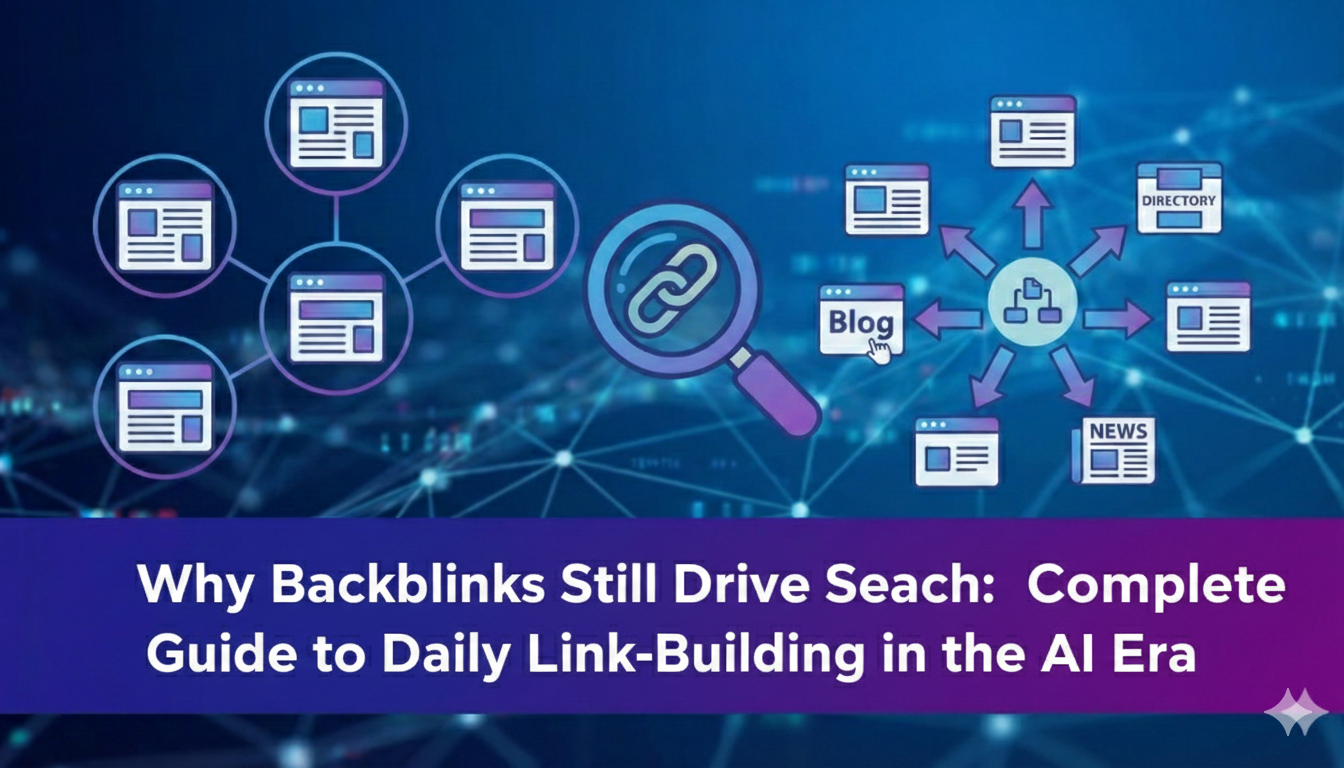
💡 Why Backlinks Still Drive Search: A Complete Guide to Daily Link-Building in the AI Era
Introduction: The Unchanged Truth of Modern SEO
SEO has evolved rapidly into an ecosystem driven by AI overviews, sophisticated conversational search, To grow consistently, businesses rely on a rank growth strategy that aligns with modern algorithms.and entity-based knowledge interpretation. Yet, amidst this technological shift, one core truth remains: Google does not take a website’s word about its own credibility. It relies on the broader internet to validate it.
In practical terms, this validation arrives through backlinks—references from external domains that acknowledge your content as trustworthy, These links are a core part of authority building solutions.relevant, and worthy of circulation. A backlink is not merely a blue hyperlink; it is digital proof of recommendation and endorsement.
Even in the AI-driven search era, Google still relies heavily on backlinks to determine:
- Credibility and Reputation
- Popularity and Authority
- Overall Website Trust Signals
When another website cites your content, it signals to Google: "This page contributes meaningful information within a topic cluster." This interpretation is what elevates a page toward ranking priority.
1. Why Consistency Matters: Backlinks Must Be Daily, Not Random
Trust in the digital world, like in offline reputation, develops through repeated exposure, not sudden bursts. When backlink work happens only in spikes—when rankings drop or competitors outpace you—Google interprets this as mechanical link-buying or short-term manipulation.
Consistency signals genuine brand emergence. Without proper tracking and analysis, many websites fail to identify gaps—this is where a link gap & toxic link cleanup becomes essential.
- ❌ 100 links in a single day: Looks manipulative (spam) — Risk of penalty/mistrust
- ✔️ 1–2 strategic links daily: Looks natural and sustainable — Best long-term trust building
Daily link activity ensures:
- Your domain continues to contribute to its industry topic
- Authority grows steadily instead of temporarily
- Crawlers return more frequently to your domain, accelerating indexing and ranking recalibration
Authority demands rhythm. Search engines measure patterns, not isolated episodes.
Safe Daily Link Velocity (Guidance)
There is no fixed "safe" number, as velocity depends on domain age, niche competition, and current authority. However, clean, niche-relevant, trustworthy links should follow natural ranges:
- Website stage:Recommended Daily Backlinks
- New Website: 2–3 backlinks/day (10–15/month)
- Growing Website: 4–6 backlinks/day (20–35/month)
- Authority Website: 5–10 backlinks/day (50–70/month)
2. What Backlinks Represent in Modern SEO: Narrative Over Numbers
Backlinks are no longer interpreted mechanically based on count. Today, a backlink is inspected as a context story. Google evaluates not only who linked, but why and where in the digital conversation your content appeared.
Backlinks today depend heavily on relevance, context, and technical quality. A strong foundation of improved indexing & crawl health ensures backlinks actually pass value.
- Topical alignment with your niche
- Editorial vs promotional placement
- Natural anchor text intent
- Clean link environment (no spam clusters)
When earned strategically, a link confirms that algorithms recognize your brand as a researched source. Careless links introduce mistrust and can drag authority down.
Core Qualification Signals for Link Prospects
- Organic traffic from real users
- Low spam score (ideally below 5–8%)
- Niche relevance over DR obsession
- Manual editorial control
- Natural anchor appearance
3. The Full Backlink Lifecycle: Crawl → Index → Trust → Rank
- Discovery (Crawl)
- Verification (Index)
- Semantic Context Check
- Toxicity & Link Neighbor Review
- Trust Accumulation
- Ranking Impact
Without proper indexing, backlinks fail to deliver results. This is why improved indexing & crawl health is critical for SEO success.
Backlinks that are unindexed, irrelevant, or removed early never transfer meaningful value.
How Long Backlinks Take to Influence Rankings
- 3–14 days: Crawl discovery
- 2–8 weeks: Index stability
- 1–3 months: Trust scoring
- 3–6 months: Ranking movement
- 6–12 months: Authority maturity
4. Backlink Processes: Daily, Weekly & Monthly
📅 Daily Tasks
- Prospect niche sources
- Qualify sites
- Send outreach emails
- Monitor crawl signals
🗓️ Weekly Tasks
- Secure contextual placements
- Review anchor distribution
- Check index status
- Analyze competitor gaps
📈 Monthly Tasks
- Perform a link gap & toxic link cleanup
- Competitor refresh
- Authority growth review
- Index verification
5. Prerequisite: The Essential Groundwork
- Technical SEO stability
- Strong improved indexing & crawl health
- High-value content
- Core Web Vitals passed
- Strong internal linking
- Healthy crawl budget
Backlinks alone are not enough—you need a complete rank growth strategy.
Authority is domain-inferred. New URLs rank faster when the domain already carries trust.
Conclusion
Backlinks are not just a ranking lever—they are the strongest continuity signal of topical trust. In an AI-driven search world, consistent editorial citations still determine semantic priority.
Backlinks remain the strongest signal of authority. Businesses that invest in authority building solutions see long-term growth and stability.
Want to build strong backlinks for your business? personalized backlink plan tailored to your goals.
Consistent, high-quality backlink work is not a mechanical routine—it is an ongoing declaration that your content remains worth circulating. Rankings that rise through repeated, validated citations maintain presence beyond update cycles because consistency, not intensity, shapes domain authority.
Focus on building 1–2 powerful links daily. Rankings don’t rise instantly, but they rise sustainably.